敦煌を目指して
私が初めて中国へ行くことができたのは、北海道札幌市の加藤誠さんご夫妻のおかげだった。加藤ご夫妻とは、私が、(財)日本国際協力センター(JICE)の北海道支所で仕事をしていた2007年から2009年の間に、知り合いになった。加藤ご夫妻は、JICEに限らず、官民主催の各国の青少年交流や留学生のプログラムの受け入れ(ホームスティ/ホームビジットなど)に積極的に協力をされていた。
加藤さんは、中国との関わりが会社の仕事でもあるわけではなく、「一度、夏休みを利用して観光ツアーに参加したのが初めての中国歩きだった」と、加藤さんの一冊目の著書、「ぶらり全省 中国大陸をゆく」(2011年9月 伏流社 @昆明市)の序文に書かれている。この本は2000年に小松製作所を定年退職された加藤さんが、その後10年間に、中国大陸を、ぶらりと全省を歩いた記録である。2冊目の著書は「私が歩いた中国世界遺産 旅とまち歩き」(2021年8月 (株)印刷紙工 @札幌市)で、一冊目同様、写真も豊富に掲載されている。
加藤さんに、このように言ったことを覚えている。「私たちの仕事は、各省庁やJICA、地方自治体などと協力して各国の技術者研修、青少年交流や行政官の受け入れなどをしてきました。そのなかには、多くの中国の方々とも交流はしましたが、まだ一度も中国へ行ったことがない人が多いのです」「加藤さんは一人か少数の友人と中国を訪問されているようですが、もしグループで旅行されるときは、北海道の私たちの事務所の希望者も入れてください。夏休みだったら、2,3人は行ける人いると思います」。それが実現したのが、2010年の夏だった。
加藤さんは、自分のボランティア仲間と学校の同窓生を誘って、男女7人ぐらいのグループをつくり、そこに私がJICE北海道支所の仮谷さん、友佳里さんを誘って3人が加わり、さらに加藤さんが率いる団体旅行を手伝う郭さんの計11人で、夏休みに甘粛省の蘭州と敦煌を目指すことにした。郭さんは、ご主人と札幌で旅行代理店を経営していて、献身的に旅行をサポートしてくださった。郭さんは出発のときから自分の荷物よりずっと大型の空のスーツケースを携行しているのが印象的だった。きっとグループのなかには、買い物などで荷物があふれる人たちが出てくることが、経験上想定されているのだと思った。直前になって仮谷さんが、夏休みの別の計画と重なって行くことができなかったのは、実に残念だった。なぜなら仮谷さんは甘粛省からJICEが受託して、札幌市などと一緒に実施した「地熱エネルギー」プロジェクトの視察と研修の担当者で、甘粛省には親しい行政官や技術者たちが楽しみに彼を待っていたからだ。仮谷さんと彼らは、仕事仲間であり、お互いに酒豪として通じ合う間柄だった。現在では日本でも中国でも、若者はお酒の飲み方が軽くなったと思われる。2010年には中国の都市部ではすでにその傾向があったが、北海道や中国の地方によっては、お酒が飲める人は友人として最も尊敬される名残りがあった。
加藤さんと一行10名は、まず上海に向かった。そこは5月から10月まで上海万博2010が開催されていた。加藤さんと郭さんは、私たちが万博を少しでも見られるように2時間くらいの時間がとってあった。サウジアラビア館はじめ、中東の国々は先端技術の展示が大人気で長時間待たないと入れないと、日本の新聞でも報道されていた通り、長蛇の列がつくられていた。
中国、韓国、欧米もメキシコなど南米の国々、インド、東南アジアの先進諸国などは混み合っていた。幸い私も友佳里さんも、日頃親しんでいる好きな国々の展示館、例えば、モンゴル、ミャンマー、中央アジアのウズベキスタン、タジキスタン、キルギスなどではゆっくり過ごせたので、大満足だった。
万博会場内には中国の大学生と思われる、若いボランティアの人たちが何か困りごとがありそうな入場者のそぶりには、すぐ駆け寄ってきて一所懸命に力になろうとして親切だった。行きたい展示館や、グループの人たちとの待ち合わせ場所などを尋ねながら、二人とも日本から持ってきたちょっとした小さなおみやげをお礼に渡しているうちに、万博会場ですっかりそのおみやげを使い果たしてしまい、中国のこの若いボランティアの人数から、中国の人口の厚みを実感した。
加藤さんの説明によると、上海から私たちは空路、甘粛省の蘭州市に行く。彼は5年前に北京から空路、蘭州市に行き、蘭州から鉄道を乗り継ぎながら敦煌まで旅行したことがある。中国の地図を広げながら、甘粛省の北はモンゴルと新疆ウイグル自治区に接していて、東は内モンゴル自治区、西は青海省だと位置を示してくれた。甘粛省はシルクロードとしても知られる砂漠地帯であるが、東西に5000メートルを超える山々が連なって、一年中氷河や雪が残っているため、その雪解け水のおかげで、広大な砂漠のオアシス地帯になっているのだ。蘭州からは鉄道で瓜州に行き、そこからまた鉄道を乗り換えて敦煌まで行くのだ。敦煌は、日本では文化、歴史、宗教、芸術、観光、自然など様々な観点から日本ではよく知られた、根強い静かな人気があるところだ。中国で敦煌は「日本人が一番好きな観光地」として知られているようだが、私の家族、親戚や友人も敦煌に歴史的、文化的な関心や憧れを持っている人たちが多かった。結果的に3人から2人になってしまったが、この旅行へのJICEの参加者は知人が多い甘粛省蘭州市と、もう一つは蘭州から車で3時間はかかると言う合作に行きたかった。敦煌も甘粛省にあるとは聞いていたが、同じ省と言っても、甘粛省の面積の広さは中国でも別格だった、と後に知った。最初に訪れる蘭州から合作まで、車で片道3時間と予定していたが、実際には2010年当時は、途中、場所によっては道路事情が悪く、そう簡単ではないと、札幌で研修をしたエネルギーや地域開発の専門家たちは心配してくれた。だれも合作には行ったことはないと言った。
加藤さんと、友人の方の中には、1980年代前後にNHKが長期にわたって放映したテレビ特集「シルクロード」で敦煌莫高窟の石像や洞窟内の日本の奈良や大和路に通じる壁画群を見て、敦煌には一層関心と親しみを持ったと言われた。1400年前、実在した唐の僧侶、玄奘三蔵が、インドに経典を求めて唐が禁じていた出国をして、そのままインドで16年を過ごし経典を書き写し、学問をし、その写しを唐に持ち帰った。そして唐に帰国後、その後の人生をかけてそれらの経典をサンスクリット語から漢訳した。これに端を発した仏教における彼の業績の偉大さは、私など想像もできない。そのうえ、子どものころから馴染んできた孫悟空や三蔵法師が登場する人気の小説「西遊記」のもとになった旅行記「大唐西域記」を著わしたのも玄奘三蔵だ。敦煌周辺には、玄奘がインドに向かう途中におとずれた記録があるそうだ。
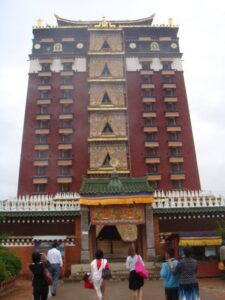
ミラレパチベット仏閣 甘粛省合作 2010年
甘粛省での再会
蘭州に着くと、加藤さんの案内で、蘭州の賑わう街のなかをみんなで歩いた。蘭州ラーメンが有名なので滞在中にぜひ行こうと話した。この日は黄河を眺めながら、白塔山に登った。登ったと言ってもすぐ頂上に着いたのは、蘭州は海抜1500メートルにある都市で、200メートルほど登れば白塔山の頂きに到着した。翡翠のアクセサリーなど、上品なデザインのお土産を売っていたので、記念に小さな仏像の飾りがついた翡翠のブレスレットを買った。白塔寺は、ラマ教の僧侶の供養のために、ジンギスハンが建立したということだ。ここは、観光地というよりも、長く人々の信仰の場であり続けた、心落ち着くところで、大変印象深かった。
次に蘭州大学を訪問し、同時に札幌で研修をした地熱エネルギーの行政官や専門家たちに再会し、皆さんから暖かく迎えられた。ホームビジットにいつも協力している加藤さんの友人グループももちろん一緒に豪華なご馳走を準備して招待してくださって、旧交をあたためた。ちょうど日程を合わせることができた、JICEの伊藤美奈子さんが北京から合流してくれて、美奈子さんは一流の通訳でもあったので助かった。美奈子さんは、中国西部にもJDS(日本外務省がODAで海外の行政官が日本の大学院で学ぶスカラーシップ)の募集・選考を拡げるため、出張で甘粛省と青海省の広範囲の行政当局と打ち合わせをしていた。2000年前後に日本がJDSを開始したときには、すでに米国も中国もASEANやアジアの青年たち、特に優秀な、後に「高度人材」と呼ばれる行政官や民間の幹部候補生対象に競ってスカラーシッププロジェクトをスタートさせていた。
米国、中国、日本の対アジア・アフリカスカラーシップ
美奈子さんのようなJICEのJDS留学生の担当職員が、中国全土を公平に日本の大学院への留学を応募促進するために説明する相手は中国の行政窓口だった。日本外務省のJDSスカラーシップはODA(無償資金協力)で、対象国は開発途上国であるはずだが、国際社会で、アジア・アフリカ諸国を対象に国際交流や協力の実績を重ねている中国の人たちには、私も「中国は開発途上国になったり、他国に援助を行う先進国になったり、どうなっているでしょうね?」と半ば冗談、半ば皮肉に聞こえることを言っていた。「まだまだですよ。技術は発展しても、日本から学ぶことはまだまだ沢山あります」と相手は答えていた。
日本外務省がODAでJDSという無償資金協力のスカラーシップを開始したのは2000年前後、1999年のラオスとウズベキスタンが最初だった。そのあとベトナム、カンボジア、ミャンマー、さらにタジキスタン、キルギスなど中央アジアが続いた。タジキスタンやキルギスに私はJDSの説明と応募促進に出張したことがあるが、すでに米国が、能力や意欲があり英語が堪能な人材を自国に留学させていた。日本の大学院に来るJDS留学生たちは、その前後に米国のObama大統領のYALI (Young African Leaders Initiative)に参加している人が私が会ったなかには少なからずいた。
米国はアフリカ各地にフォローアップセンターも設立して、それらセンターで帰国後も相談できると聞いて、米国の文化や価値観を理解させる継続性、グローバル化する企業、金融人材を確保する戦略が一貫していることにいまさらながら感嘆した。
一方、価値観を共有する国々は、様々な中国の政府奨学金や、Obama大統領のYALIと時期を重ねて中国が起業の実地を学ばせた民間のジャック・マー(アリババ)財団の奨学金にもよく精通していた。
中国政府とジャック・マー氏のコラボレーションはどこかで解消されたかに見受けたが、社会主義の傘下の国々出身の学生や起業を目指す若者にとっては、当時、中国もまだ米国のような伝統的大企業を持たないなかで、ジャック・マー氏の成功体験は大変刺激的で鼓舞されたことだろう。
2000年前後にスタートした米国、中国、日本の各スカラーシップは、企業も人間もグローバル化を視野に、スカラーシップを通して米国も中国も日本もそれぞれ自国の価値観外交を展開し、米国、中国は上記のようにスタートした。一方日本は、当時、英語で大学院で教育することができる大学は限られていた。特に最初はIMF主導で、財政・金融などを学ばせるというテーマが持ち込まれたが、それに手を挙げる大学は全国的にごくわずかで研究室と教授は限られていた。日本の学生がそもそも財政・金融を学ぶことに関心は低いという説明は多くの大学で共通していた。その分野を研究するのであれば大学院は米国に行くだろうと。そこで日本ではJDSは受け入れられる科目であれば大学に任せるということで、ようやく受け入れが軌道にのるためには5~6年は要した。
JDS留学生の報告書や寄稿文には、日本では、人材が育つプロセスを、教員がやってみせることで、気づかせる体験をさせることが、大学の教育制度の中に組み込まれているということにふれている。研究室という共同体、指導教員の献身性、利他的で誠実な人間関係など、日頃当たり前だと気が付かなかった日本社会を大いに評価していた。
甘粛省合作へ
蘭州で、私、友佳里さん、美奈子さんと、加藤さんとその友人たちは一日別行動をとることになっていた。
私たち3人は、蘭州から車で約3時間のところにあると聞いていた合作の甘粛民族師範学院を訪ねることにしていた。
この大学は、まだ完成はしていなかったが、その学長が中央党校の視察団の一員として日本の北海道を訪れて地域開発や高等教育の専門家と交流した。行政の各機関や大学を訪問して特に北海道大学は、中央党校というものが何であるかよく認識していて、活発な意見交換が行われた現場に私も同行していた。中央党校は、胡錦涛主席が創立した中国全土から共産党幹部候補生を100人を選抜し、北京に集め、1年間、理論と実地を研修する党校だった。胡錦涛政権下ではここでまず、中国各地の幹部候補生は交流し、毎夏には海外研修が3グループに分かれて行われて、30数人ずつ、日本の他にはシンガポールと韓国に派遣された。日本グループはさらに3グループに分かれて、東京から例えば北海道(札幌)、関西(神戸)、九州(福岡)というように10数人ずつ訪問が行われた。
中央党校の研修期間中のプログラムにはホームステイがあり、受け入れ家庭候補の一つに前鼻多喜美さん宅があった。彼女は札幌市西区の丘の上に広大な自宅があって、敷地内に彼女が経営する印刷工場と事務所があった。多喜美さんは、大変なタレントでプロのアナウンサーに負けないような透き通った声と発声で結婚式や行事のMCをよく依頼されていた。先祖は広島県から北海道に屯田兵として入植して、多喜美さんで5代目になり、先祖の努力や足跡を子供や孫たちに話して聞かせている様子だった。札幌では、市長や民間企業、大学などが主催する定期的な勉強会があり、前鼻さんとはその一つで知り合い、意気投合し、私は東京に戻ってからも、多喜美さんが創設したNブリーズと、その関連組織である北海道の若者を、全国的視野で育成したいというボランティアを継続的に手伝った。多喜美さんは中国との交流にも積極的で、ご子息の一人は精華大学に留学させていたので、中央党校のホームステイにも応じてくれた。できれば中国の西部や後発地域の人たちには優秀で人知れず献身している人たちがいるのだろうから、そういう人たちに会いたいと言った。そこで甘粛省の民族師範学院の院長、同じく甘粛省の農業大学学長、寧夏回族自治区の党幹部の方の3名の1泊2日のホームステイをお願いした。当日、多喜美さんが私も最初だけ一緒にいて紹介してというので同行した。通された応接間のガラス張りの窓から札幌市が丘の上から展望できる絶景で、夜景になるとさらにきれいな光景なのだろうとびっくりした。ご子息2人がさっそく中国語や英語で話がはずんでいた。このお宅ではきっと北海道開拓の先祖の挫折や成功、あるいは次世代の教育上の課題など何でも話し合えるだろうと、私は静かにお暇した。
合作の民族師範学院への行き方は、旅行代理店の郭さんが、タクシーを手配してくれていたのだが、郭さんも合作までの手配は経験がないと言いながらやや不安を感じていたと思ったし、私も甘粛省の地熱エネルギーの専門家の高さんが、歓迎の昼食会のあと合作までの地図を見ながら、行ったことがないところだが学院まで車で3時間で行けないような気がする、と心配し始めた。2、3人で相談していたが、学院に連絡してくれたらしい。すると学院では、院長の運転手さんが私たちを迎えに行くことになっているという。
翌朝、学院の運転手さんが車で来てくれた。2010年のことだから、現在は見られない光景や景色を私たちは眺めながら合作に着いたと思われる。合作までの3時間の道のりは、蘭州から南へ向かって走行したはずで、今地図を見ると、「臨夏」、「甘南」あたりを通ったと考えられる。甘粛省内でも際立って異なる文化圏に入ったことがわかった。道路はまだ舗装されていないところが多く、砂利が混ざっているところもあった。頑健な車両と、道に精通し、熟練した運転手でないと安全に目的地には行けないとすぐ悟った。
イスラムのモスクがあちこちから目に飛び込んできた。建物といえば、緑色の丸い屋根をしたモスクが目立って、その周囲は人がやや集まって居住している地区だと見受けられた。時々、私たちが珍しいのか、立派なドイツ車(ベンツ)への好奇心からか車の近くから覗き見る男の人たちがいたが、女性はあまり見かけなかった。広くて平たんな道路をひたすら走るという区間もあった。そこは緑の樹木はほとんどなく殺風景だった。
合作の民族師範学院に着くまでに2か所で車から降りた。最初は全体の3分の2を通り過ぎた辺りだっただろうか。そこには大学(学院)から2名の先生が私たちを迎えに来てくださった。大きな看板と、その向かいに石碑が立っているだけのところだったのだが、重要な目印、あるいは記念碑になるべき場所のようだった。それは2000年ごろまでそれ以上内部には、特別な許可を得た人と居住者以外は通行禁止だったと説明してくださった。次に案内されたのは、チベット仏教の寺院であるミラレパ仏閣だった。8階か9階建ての荘厳な仏閣で、寺院内での祈りのお作法は、私の経験のなかでは、モンゴルのラマ教に似ていた。この二つの案内してくださった場所は、学院の先生たちにとっては、貴重な、意義深い場所だということがしみじみと伝わってきた。
到着すると副院長が挨拶に来られた。「実は、昨日は事態が流動的だったので、言えなかったのですが、同じ甘南チベット族自治州 の舟曲で、洪水による土砂崩れがあり、死者・行方不明者多数続出している。昨日北京から温家宝首相が現地入りし、指導に当たっている。院長も召集がかかり、『お会いできないのは大変残念ですが、あとは副学長に任せますが、大歓迎です。よろしく伝えてください』と言って今朝早く出張しました」と言われた。舟曲でおよそ1700人が死亡し、300人近くが行方不明になっているという惨事が起こっていた。北京政府もチベット・少数民族の被った災害には万全の対策をとったのだろう。そのときはそれは大変なことが起こったという気持ちはあったが、広大な中国でも少数民族への対応には万全を期する方針もあったのだろうと、民族師範学院の今後の役割も重ね合わせて考えた。その晩のテレビでは、温家宝首相が土砂崩れの現場で、崩壊した家屋と土砂に閉じ込められた人々を励まず映像が、繰り返されていた。
5年後に再会を!
副院長と夫人と小学生と思われる息子さん、それと数名の学院のスタッフは、誠心誠意私たち3名を歓待してくださった。1年前の2009年に学院として認可され、院長を筆頭に大学で働く人たちは、近くの大学の寮に居住しているそうだ。院長も普段は寮に寝泊まりして、開校までの準備を進めているようだった。立派な図書館をまず完成させることが優先されているようで、図書や資料は十分充実しているように思ったが、現在、中国全土からチベット語の文献を収集することも行っているそうだ。チベット語の書籍の開き方や文字など、私は初めて目にし、説明を受けた。図書館以外の本校が完成していないので、昼食は校庭の仮設テントの中でとりましょうと、さわやかな空気の流れを感じながら、野菜と肉と果物、ケーキなどのご馳走をいただいた。
この日、別行動をした加藤さんのグループとの夕方の約束の時間に合流するため、また大学の車で送っていただいた。副院長は、「5年後にまた来てください。そのころには大学の建設も完成し、授業も開始される予定ですから」と言われた。大学からのお土産に硯をいただいた。私たち3人と、院長がホームステイをした前鼻さんに渡してほしいと、もう一つの硯を渡された。緑色に微量の灰色を落としたような美しい緑色の硯で、縁には彫刻がしてあった。私たちは札幌から当時中国でもまだ珍しく人気だったお菓子「白い恋人」などある程度は渡すことはできたが、中国では相手の人数が多いので、数はいつも十分ではなかった。簡素になってきたとはいえ、日中間には根強い贈答文化がもっとも盛んなころでもあった。私たちのお土産は、立派な洮河緑石(とうがりょくせき)の硯にははるかに及ばなかったが心を込めたお礼だった。あれから15年後の現在、合作は中国のどの地域にも負けない近代化への変貌を遂げていることだろう。
蘭州駅には発車間際で間に合った。地熱エネルギーの研修員たちが10名ぐらい見送りに来てくれていた。急いで預けてあった私と友佳里さんの荷物を列車に運んでくれて、慌ただしく別れを惜しんだ。合作に近いの洪水のニュースが大きく取り上げられていたこともあり、だいぶ心配させてしまったと後で申し訳なく感じた。周囲の皆さんの計らいで予定通り、甘南自治州内を往来できたのだが、二人とも初めての中国旅行としては無謀だったかもしれない。関わってくださった甘粛の方々を思い出しながら、感謝の気持ちはいつまでも褪せることはない。
蘭州から酒泉へ
蘭州から新疆ウイグル州をつなぐ蘭新鉄道に乗って、砂漠のなかの一画を占める広域の市、酒泉に向かった。中国では、市とか県といった行政区分が日本と定義が異なるので、確かめる必要がある。酒泉は敦煌より広域の市で、瓜州や敦煌は酒泉に含まれる地域だそうだ。現在は、蘭州から敦煌まで鉄道がつながっているようだが、2010年は、いったん瓜州で下車して、敦煌まで乗り継ぐので蘭州からおよそ15時間弱の行程だった。ゴビ砂漠のなかのオアシスの広域都市が酒泉で、歴史ある交易の街の雰囲気があった。「夜光杯」の産地としても有名だということで、その製造元を訪ねた。様々な緑色の食器や工芸品が並べられていて、美しい。原石からこのような緑の製品が創られていくのだそうだ。私もお土産に夜光杯の作品をいくつか買ったが、自分が一番気に入ったのは、唐の詩人、王翰(Wang Han)の涼州詩の書だった。現代の書家の作品が掛け軸になっていた。今は大切に自宅に飾ってある。
葡萄美酒夜光杯
欲飲琵琶馬上催
醉臥沙場君莫笑
古來征戰幾人回
注:和訳
葡萄酒の美酒を、夜光杯に注ぎ、
さあ飲もうとしたその瞬間、
馬上で琵琶が鳴り、出陣を急かされる。
もし酔って戦場の砂に倒れても、笑わないでほしい。
昔から、戦に出て生きて帰れた者が、いったい何人いただろうか。
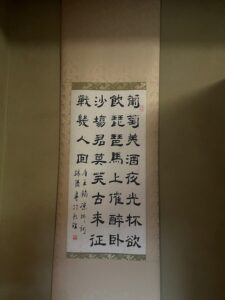
王翰の涼州詞の書
敦煌莫高窟
敦煌は、紀元前からシルクロードの拠点として知られているが、3世紀にはすでに西域の仏教の僧侶たちが往来し、学問の場でもあったそうだ。敦煌では、敦煌太陽大酒店というホテルに宿泊し、ホテルから南に15キロメートルにある石窟、莫高窟を訪ねた。紀元前4世紀、前秦から14世紀、元まで1000年の間、10の王朝によって継続され、492の石の洞窟に仏像や壁画が描かれ展示されている。全部が公開されているわけではなく、また見る人も一人が見る洞窟の数も制限がある。中は真っ暗だが、保全のためか照明がないので、説明員が懐中電灯で一つひとつ説明してくれる。大自然のなかに、一つひとつの洞窟の内部に入いると、年代ごとの大規模な美術館が建ち並んでいるかのようだ。1000年の歴史の足跡が、静かにここに存在している神秘さとスケールの大きさに圧倒された。
仏像は日本の仏像に通じる、自然体で控えめな雰囲気があった。壁画は天女や浄土が描かれているものがあり、奈良のお寺や美術工芸品の絵柄を思い起こさせた。中国の若い説明員も、日本からの訪問者や観光客には、日本の特に奈良の仏像や壁画への影響や類似を話すのだが、写真でみるだけで、まだ日本に行ったことはないと言っていた。敦煌の何人かの研究者たちから日本の全県をまわったとか、いろいろ招待を受ける話を聞いたが、研究者でなくても、海外との仕事に関わる若い人に、少しでも青少年交流の枠を活用すればもっとよいのに、思わず仕事のことを考えてしまった。
敦煌のお土産
宿泊しているホテルで、朝食の後、ロビーを通りがかると、男の人が一人、机の上に大小様々な石の印材を売っていた。そういえば私の弟の一人が、当時趣味で篆刻をして、かなり一所懸命やっていた。「中国に行くのなら、印材を買って来て」と言っていたのを思い出した。この弟は、中国文学を専攻して、漢詩などにも精通していたので、私が敦煌まで行くのをうらやましがっていた。印材など私はまったくわからなかったが、彼が売っているちょっときれいな石は、小さくても一つ3000円とか5000円とか私には高すぎた。日本人には特に人気の敦煌のホテルだから日本人の好みもわかっているのか、たしかに珍しい印材や大振りの印材など豊富だった。いろいろあって迷うので、一つや二つだけ買うというわけにはいかない気がした。「クレジットカードで支払えますか?」と聞くと、「あぁー、うちは現金しか使えないのですよ」と残念そうに答えた。私もほんとに欲しい石がいくつかあったので、買えないと言われるとちょっと残念だったが、同時に散財しなくてよかった!とほっとした。その夕方、私たちが莫高窟からホテルに戻ると、同じ印材やさんがにこにこしながら話しかけてきた。「お客さん、クレジットカードが使えるようになりました。友だちから機械を借りてきたので」と言う。2000年代の中国は、その完成度はそれぞれのようだが、必要なことはすぐ対応する、その迅速さには何度も驚いた。これが私が最初に目撃した実例の出来事だったような気がする。私は驚くというより感動して、印材を4つか5つ弟にお土産として持って帰った記憶がある。
敦煌に延べ何人の日本人が、観光や学術研究、あるいはおそらく壁画の修復の技術者や職人などが、訪問したのかわからないが、あちこちで日本と中国の絆を感じた。有名無名を問わず芸術家や研究者、小説家やジャーナリスト、僧侶や寺院の関係者などが、日本と中国の間で、間断なく往来してきたのだろう。
もっともシルクロードは、中国と日本だけで語られているものではもちろんない。私はタジキスタンに仕事で行ったことがあるが、規模はもっと小さかったが、シルクロードの複数の交差点と言われるタジキスタンで、奈良にある美術に似た、タジキスタンの壁画の修復を、東京都の文化財保護の団体から派遣された技術者が長期間にわたって携わっていたの知った。タジキスタンには世界一長身の涅槃像(仏像)がある。バングラデシュでも多くの仏像を保管し展示している博物館を訪ねたことがある。イスラムの国々は、仏教遺産を観光資源として活用するには限界があるのかもしれないと、そのときは思ったものだ。
敦煌では、仏教や仏教美術に親しみを持つ海外からの訪問者のための記念品やお土産の、工芸品を創り、絵画や書などを描く専門の画家や芸術家が仕事をする研究所があるという。それらの作家の作品は、観光用のお土産もあるが、芸術品としても価値があるものも同時に売られている。
この日は皆で敦煌の街に出て加藤さんが以前行った事があるお土産さんに行くことになった。それら各種の膨大は作品群は、面積の広さも、天まで届くそうな天井の高さといい、これまで見たことのない壮大な体育館のような建物の中に、まず大きな絨毯が天井から床まで展示されて、棚や机の上にも様々な絨毯や刺繍や帽子などが並べられていた。絵画も仏教に伝わるテーマが描かれたものが主流で、現代を代表する敦煌や中国各地の創作者、研究所の教授や若い画家など、仏教の知識があればもっと楽しめるのだろうが、私でもわかる菩薩の絵もあった。白象に乗った普賢菩薩の絵は、象をコレクションしている母の故郷山口県の、臨済宗のお寺、峨眉山普賢寺と自分のために2点購入した。2枚のうち1枚は絹地に描かれたものだった。あとは2,3枚、ややモダンな気に入った絵を買った。絵は全部帰ってから表装してもらうので荷物にはならなかった。それを皮切りにあたりを見回すと、いろいろ欲しくなって、特に天井の一番上に展示されていた紫の地に緑色の龍をを描いた大判の敷物の絨毯に知らず知らず見とれていた。私が見とれている様子を逃さないかのように係りの人が、消防署かサーカスで使うような長い梯子を持ってきて、たちまち、30メートルぐらいをスルスルと登って、重量もありそうな絨毯を素早く床まで降ろした。「これは見事でしょう?あなたはさすがです!一番上等な優れた作品ですよ」とその担当者らしき人は胸を張った。「あなたが気に入ったら、特別な割引をします。本当のことを言いますと、今年は上海万博があるので、観光客が多いと予想して作品を多く準備したのです。日本人は敦煌には足を運ぶだろうって期待していたのですが、どうも上海万博に行く人と、敦煌に来る人の客層は違っていました。全然客足が伸びないので、3割ぐらいは値引きします」亡くなった父は辰年だったので、それもあってこの絨毯は仏間に敷くのにぴったりだった。その絨毯よりは小さめの、牛が何頭か図柄になっている珍しい絨毯を買った。丑年のもう一人の弟を思い出したからだ。
私が絵や絨毯にとりつかれたように買いものをしているのを見ていた加藤さんが、「ヤマノ財閥!日本に帰ってから大丈夫かい?」と大声で冗談っぽく言った。そんなにお金を使って、日本に帰ってから生活できるの?っていうことで、みんなで笑ってしまった。グループの佐々木さんが「ヤマノさんは、見ると何でも欲しくなってしまうのよね」と言ったが本当に敦煌にもっと長く滞在していたら、私は本当に帰ってから生活できなくなっていたかもしれない。ところで頼りのクレジットカードで支払おうとしたら、上限金額を超えて支払えないと言う事態になった。加藤さんはこれでよかったというような顔をされたが、私は本当に気に入ったものばかりで、しかも中国側は、敦煌から日本への配送は慣れているので問題は、クレジットカードの上限額だった。ふつうここでみんなあきらめるところだが、その担当者はなにやら私のクレジットカードを手に電話をしていたが、しばらくすると、私のカードの上限額を変更してもらえたので問題ないということになった。きっと私のような人、敦煌で何でも欲しくなる人は結構な数いるのだと、私は理解した。帰国後、敦煌でのお土産品は、すべて問題なく敦煌から自宅まで無事到着して、その後予定通り、すべて両親の家の仏間に置き、普賢菩薩像の一枚は表装してから、母の故郷にある峨眉山普賢寺に私が携行した。普賢寺の象堂方丈様が本堂の天井高く、額縁に入れたその絵を飾ってくださった。飾る場所が見上げるばかりの高いところで、人の眼に触れにくいが、大切にしてくださる気持ちの表れなのだろう。
私は仏教に対しての知識や教養は薄いうえ、信仰が厚いというものではないが、多くの日本人同様、小さいころから、、神道や仏教的環境のなかで生活してきたので、神仏は尊いという気持ちは常にある。奈良をはじめ京都、鎌倉など各地のお寺も折にふれてお参りや観光をしてきた。私も敦煌から奈良への道のりに想いを馳せ、懐かしさや親しみを感じた一人だった。
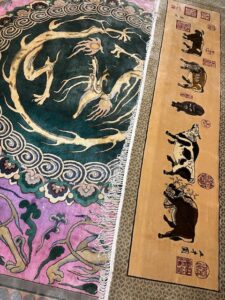
絨毯 龍と唐代五牛図
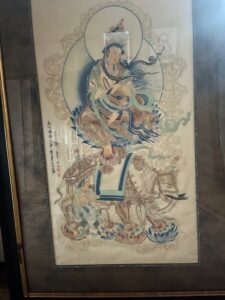
普賢菩薩像1
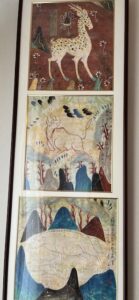
現代仏教美術作品
ラクダに乗って ━ 鳴沙山(めいさざん)と月牙泉(げつがせん)
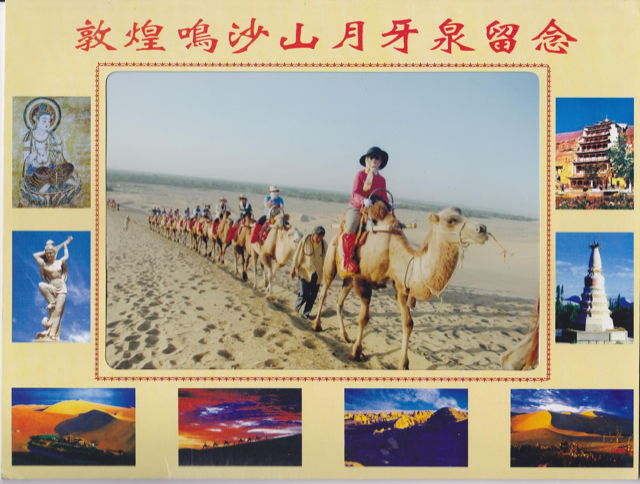
敦煌での最後の訪問場所は、鳴沙山という、自然が長い年月のなかでつくり上げた巨大な砂丘群とそこにある、6000年前から水が湧き出ているという月牙泉というオアシスだ。見渡す限り一面の砂漠と延々と連なる砂丘で、莫高窟が市街地のホテルから南東に25キロ、鳴沙山と月牙泉は南に5キロのところにある。
ここで一人一人ラクダに乗って隊列をつくって、砂丘の山、鳴沙山に向うのだ。靴を赤いやわらかいフェルトの長靴に履き替えて、うずくまって待っているラクダのところに行って乗る。
私は靴の履き替えに少し手間取って他に人たちを追いかけて、ラクダが待っているところまで10メートルぐらい、砂漠のなかを走ろうとしたのだが、砂が思ったより深く、足をとられて進めず「大変だ!」と焦ってしまった。ラクダに乗らないことにはとても進めないと痛感した。ラクダは馬の背よりも数段高い気がした。ラクダの背にはコブが二つあって、その間にゆったりと座れるので初めてでも怖くはなかった。体高は馬より高くても、体の幅が広いのでくつろげる感じがした。何より少なくとも私が乗ったラクダは人になついていてかわいかった。ただラクダも馬と同じで、人を見て扱いやすいと瞬時に察すると、好き勝手なことをし始めるとわかったので、気を引き締めた。敦煌や近隣の人たちが観光のためのラクダを、多くは自宅に連れて行って飼育し、観光業のために提供している提携関係があると聞いた。そのためかラクダは人懐こく、日頃かわいがられている様子が窺えた。
鳴沙山をゆっくりと隊列をつくって歩くときは、隊列の先頭、中間、そして最後にそれぞれ3人の係り配置されてラクダを引いて砂の上を歩いて隊列を誘導してくれた。道中にはカメラを向けて、写真をとる係りの人もいて、希望者はラクダを降りると写真を買うことができた。途中で降りて写真を撮り合う余裕はないので、参加者にとってはとても貴重な記念写真となった。
時間的にどのくらい乗ったのかわからなかったがたっぷり1時間以上はかかったと思う。途中で、出国を禁じられていた唐の時代に仏典と学問を求めてインドに向かった玄奘三蔵法師が自身が、立ち寄ったことを記しているオアシス、月牙泉に寄って敦煌の旅を閉じることになった。
帰国したら敦煌の書籍やビデオを見聞してもう一度来たいと思ったのだが、もう2度と訪れる機会はないだろう。また敦煌の姿もだいぶ変容してしまったかもしれない。というのはこれまで制限なく訪問できた石窟群は、2010年の私たちが訪れた頃からは、壁画の傷みなどのために修復や入場制限が始まっていた。同時に加藤さんのような「ぶらり中国大陸をゆく」という自由な人と人の交流の時代がいつまでも続くのかは当時はわからなかった。
敦煌周辺には日本の「創価学会」や、創価学会の「池田大作会長」の看板がとても目に付くところに建てられていた。敦煌周辺では大変感謝されているようだった。おそらく敦煌に関する学問や文化遺産への協力や支援が手厚かったのだろう。それは当時の創価学会の歴史から言っても、政治的なことではなく、純粋に仏教への信仰と学問上の信念からだと私には推測できた。私は創価学会にはほとんど親近感を持ったことはなかったが、日本では知られていない貢献を知って非常に驚いたことは現在に至るまでよく記憶している。
このように私の初めての中国旅行は、甘粛省で暖かい中国の方々に再会し迎えられたこと、そして加藤さんが選んでくださった訪問先は敦煌だったことで、いつまでも心に残り本を読み、ビデオを見て、加藤さんと郭さんの企画に感謝した。その時は、2010年以降、自分が中国に仕事で何度も北京、上海、南京、蘇州、塩城などに行くことになるとは思ってもみなかった。私の最初で最後ののどかな中国旅行だった。
了
On the Road to Dunhuang
It was thanks to Mr. Makoto Kato and his wife from Sapporo, Hokkaido, that I was able to visit China for the first time. I came to know the Katos between 2007 and 2009, when I was working at the Hokkaido Office of the Japan International Cooperation Center (JICE). The couple had long been actively involved not only in JICE programs but also in various youth exchange and international student programs hosted by both government and private organizations, offering homestays and home visits to participants from many countries.
Mr. Kato’s connection with China did not come from his professional work. As he wrote in the preface to his first book, Wandering Through All Provinces: Traveling Across the Chinese Mainland (Furyusha, September 2011, published in Kunming city), his “first encounter with China was simply joining a sightseeing tour during a summer vacation.” The book chronicles the travels of Mr. Kato, who retired from Komatsu Ltd. in 2000, as he wandered through every province of mainland China over the following decade. His second book, My Journey Through China’s World Heritage Sites: Travels and City Walks (Insatsushiko Co., August 2021, Sapporo), is similarly rich with photographs.
I remember telling the following to Mr. Kato:
“Our work has involved collaborating with various ministries, JICA, local governments, and others to conduct technical training programs, youth exchanges, and host administrative officials from various countries. While we have interacted with many visitors from China, many of our staff have never been to China themselves.”
“Mr. Kato, I understand that you have visited China either alone or with a small group of friends. If you ever plan to travel as a group, please consider including those from our Hokkaido office who wish to join. If it’s during the summer holidays, I think two or three of us could probably go.”
That wish came true in the summer of 2010.
Mr. Kato invited his volunteer friends and former schoolmates to form a group of about seven men and women. I then invited Mr. Kariya and Ms. Yukari from the JICE Hokkaido Office, making three of us, and together with Ms. Kaku, who helped organize the group tour led by Mr. Kato, we became a party of eleven aiming for Lanzhou and Dunhuang in Gansu Province during the summer vacation.
Ms. Kaku and her husband ran a travel agency in Sapporo, and she supported our trip with dedication. It was striking that to see her carry an empty suitcase much larger than her own luggage. I assumed it was based on experience, anticipating that someone in the group would end up with overflowing bags after shopping.
It was truly unfortunate that, at the last moment, Mr. Kariya could not join us due to schedule conflict with his summer plans. He had been the JICE project officer for the “Geothermal Energy” program commissioned by Gansu Province and implemented together with the City of Sapporo and others. Many familiar administrative officers and engineers in Gansu had been looking forward to welcoming him. Mr. Kariya and his counterparts there had worked together and bonded particularly well as fellow heavy drinkers. Today, it is said that young people in both Japan and China tend to drink less than before. That trend was already visible in urban China around 2010. Yet in Hokkaido and in certain parts of China, those who could drink well were still regarded with a certain respect as good friends.
Our group of ten, led by Mr. Kato, first headed to Shanghai, where the 2010 World Expo was being held from May to October. Thanks to arrangements made by Mr. Kato and Ms. Kaku, we could see at least a little of the Expo for two hours. As reported in Japanese newspapers, the pavilions of Middle Eastern countries, especially the Saudi Arabia Pavilion, were extremely popular for their displays of cutting-edge technology, and the queues stretched endlessly.
China, South Korea, Europe, the United States, as well as Mexico and other Latin American countries, India, and the more developed countries of Southeast Asia were all crowded. Fortunately, both Ms. Yukari and I were able to spend time at the pavilions of countries we felt close to such as Mongolia, Myanmar, Uzbekistan, Tajikistan, and Kyrgyzstan without the long lines. We were more than satisfied.
Inside the Expo grounds, young volunteers, mostly Chinese university students, would immediately rush over whenever they sensed that a visitor might need help. They were earnest, eager, and very kind. As we asked for directions to various pavilions or to our meeting points, we handed them the small souvenirs we had brought from Japan. Before long, we had given them all away. The sheer number of these young volunteers made me feel the depth and scale of China’s population.
According to Mr. Kato, from Shanghai we would fly to Lanzhou which is in Gansu Province. Five years earlier, he had also flown from Beijing to Lanzhou, and from there traveled to Dunhuang by taking several connecting trains. Spreading out the map of China, he pointed out that Gansu Province borders Mongolia and the Xinjiang Uyghur Autonomous Region to the north, Inner Mongolia to the east, and Qinghai Province to the west. Gansu Province is a desert region also known as the Silk Road, yet it features mountain ranges stretching east to west that exceed 5,000 meters in height. These mountains retain glaciers and snow year-round, and thanks to the meltwater from this snow, the vast desert has become an oasis region.
From Lanzhou, we would take a train to Guazhou, and then transfer to another train to reach Dunhuang. In Japan, Dunhuang is well-known from various perspectives—culture, history, religion, art, tourism, and nature—and has quietly maintained deep and steady popularity. In China, Dunhuang seems to be known as “the most popular tourist destination among Japanese people.” Indeed, many of my family members, relatives, and friends have long held historical and cultural interest in or admiration for Dunhuang.
Although the group ended up being two people instead of three, the JICE participants for this trip wanted to visit Lanzhou City in Gansu Province, where many acquaintances reside, and Hezuo, which is said to be a three-hour drive from Lanzhou. I had heard that Dunhuang was also located in Gansu Province, but only later did I come to understand that Gansu’s sheer size is exceptional even for China’s standards.
From Lanzhou, our first stop, to Hezuo, we had planned a three-hour drive each way. However, the energy and regional development experts we trained with in Sapporo back in 2010 expressed concern that the road conditions were poor in some areas along the way, making it not so straightforward. They also said no one had been to Hezuo to know for sure.
Mr. Kato and some of his friends mentioned that they developed a deeper interest in and familiarity with Dunhuang after seeing the stone statues and cave murals reminiscent of Nara and the Yamato region in Japan during the NHK television series “Silk Road,” which aired over a long period around the 1980s.
About 1,400 years ago, the Tang-dynasty monk Xuanzang defied the state ban on leaving the country and traveled to India in search of Buddhist scriptures. He spent 16 years in India copying texts and studying, then brought those copied scriptures back to Tang China. Upon returning home, he devoted the rest of his life to translating them from Sanskrit into Chinese. The greatness of his achievements in Buddhism is beyond anything I can fully comprehend. Moreover, Xuanzang is the one who wrote the travelogue Great Tang Records on the Western Regions (Da Tang Xiyu Ji), which later became the basis for the beloved classic novel Journey to the West, featuring Sun Wukong and the monk Tripitaka, characters familiar to us since childhood. It is said that Xuanzang visited the area around Dunhuang on his way to India.
Milarepa Tibetan Buddha Pavilion Hezou, Gansu province 2010
A Reunion in Gansu Province
Upon arriving in Lanzhou, we all walked through the bustling streets under Mr. Kato’s guidance. Lanzhou is famous for its noodles, so we agreed to make sure to try them during our stay. That day, we climbed Baita Mountain while enjoying views of the Yellow River. “Climbed” is perhaps a generous word. The city itself already sits at an altitude of 1,500 meters, so ascending just about 200 meters brought us to the summit.
Along the way, I noticed shops selling jade accessories with elegant designs, and as a memento, I bought a jade bracelet adorned with a small Buddha figurine. Baita Temple, I learned, was built by Genghis Khan to honor Lamaist monks. The site, more than a tourist attraction, has long been a place of faith for people, a place that calms the heart, and it left a deep impression on me.
Reunion in Gansu Province
Upon arriving in Lanzhou, we visited Lanzhou University and were reunited with the geothermal energy officials and experts who had previously taken part in training programs in Sapporo. We received a very warm welcome from all of them. As always, Mr. Kato’s group of friends, who regularly support home visits, joined us and prepared a lavish meal, giving us a wonderful opportunity to renew old friendships.
Minako Ito from JICE was also able to join us from Beijing, as our schedules happened to align. She was an outstanding interpreter, which was an enormous help. Ms. Ito was on a business trip, holding meetings with a wide range of administrative authorities across Gansu and Qinghai Provinces, with the aim of expanding the recruitment and selection of candidates in western China for *JDS.
Around the year 2000, when Japan launched the JDS program, the United States, China, and ASEAN countries had already begun competing to establish scholarship projects targeting young people across Asia, particularly outstanding individuals who would later come to be described as “highly skilled human resources,” including government officials and future leaders in the private sector.
U.S., China, and Japan Scholarships for Asia and Africa
The JICE JDS scholarship officers, like Minako, promoted applications for graduate studies in Japan across China by explaining the program to Chinese administrative offices. The Japanese Ministry of Foreign Affairs’ JDS Scholarship is funded through ODA (Official Development Assistance), and its target countries should be developing nations. Yet, to the Chinese people, who have built a strong track record of international exchange and cooperation with Asian and African countries within the international community, I would sometimes say, half-jokingly, half-sarcastically, “I wonder what China is now? A developing country, or a developed nation providing aid to others?” “Not at all,” they replied. “Even as our technology advances, there’s still so much to learn from Japan.”
The Japanese Ministry of Foreign Affairs launched the JDS grant program under ODA around the year 2000, with Laos and Uzbekistan being the first recipients in 1999. Then came Vietnam, Cambodia, Myanmar, and after followed by Tajikistan, Kyrgyzstan, and other Central Asian countries. I traveled to Tajikistan and Kyrgyzstan to explain the JDS program and encourage applications. However, motivated candidates with strong English skills were already invited to study in the U.S. Among the JDS students who came to Japanese graduate schools, quite a few had participated in President Obama’s YALI (Young African Leaders Initiative) before or after their time in Japan.
I was struck anew by the consistency of the U.S. strategy: establishing follow-up centers across Africa where returnees could seek advice, fostering continuity in understanding American culture and values, and securing talent for globalizing corporations and finance.
Meanwhile, countries sharing similar values with China were well-acquainted with various Chinese government scholarships and, overlapping with President Obama’s YALI, the private Jack Ma (Alibaba) Foundation scholarships that provided hands-on entrepreneurship training.
While the collaboration between the Chinese government and Jack Ma seemed to have dissolved at some point, for students from socialist-aligned countries and young people aspiring to entrepreneurship, Jack Ma’s success story must have been immensely stimulating and inspiring at the time, especially since China itself still lacked traditional large corporations like those in the US.
The scholarship programs launched around the year 2000 by the U.S., China, and Japan aimed to globalize both corporations and individuals. Through these scholarships, the three countries each pursued their own values-based diplomacy. The U.S. and China began as described above.
Japan, however, faced limitations. At the time, only a handful of universities could offer graduate education in English. Initially, the IMF-led program focused on teaching finance and monetary policy, but very few universities volunteered, resulting in limited research labs and faculty. Many universities shared the explanation that Japanese students had little interest in studying finance and monetary policy to begin with. They assumed that if students wanted to research that field, they would go to graduate school in the United States. Consequently, in Japan, the JDS program adopted a policy of leaving course selection to the universities as long as the subjects were acceptable. It took five to six years for the program to finally gain traction.
Reports and contributions from JDS students highlight how the process of nurturing talent is embedded within the university education system. This involves faculty demonstrating the process themselves, enabling students to experience and recognize its value. They valued aspects of Japanese society they had previously taken for granted: the research lab as a community, the dedication of advisors, and the altruistic, sincere human relationships.
*JDS: the Japanese government’s ODA-funded scholarship program under the Ministry of Foreign Affairs, which enables overseas government officials to study at graduate schools in Japan
To Hezuo, Gansu province
In Lanzhou, it had been decided that Yukari, Minako, and I would spend the day separately from Mr. Kato and his friends. The three of us planned to visit Gansu Normal University For Nationalities in Hezuo, which we had been told was about a three-hour drive from Lanzhou.
Although the university had not yet been fully completed at the time, its president had previously visited Hokkaido, Japan, as a member of an inspection delegation from the Central Party School and exchanged views with experts in regional development and higher education. I accompanied the delegation as they visited various government agencies and universities. Hokkaido University, in particular, had a clear understanding of what the Central Party School was, and I witnessed lively and substantive discussions took place.
The Central Party School was an institution established under President Hu Jintao, which selected one hundred prospective Communist Party officials from across China and brought them together in Beijing for a full year of training combining theory and practical experience. Under the Hu Jintao administration, these participants first built networks among themselves, and every summer they were divided into three groups for overseas study programs. Each group, consisting of a little over thirty members, was sent to Japan, Singapore, or South Korea.
The group assigned to Japan was further divided into three subgroups, with visits of around a dozen participants each to regions such as Hokkaido (Sapporo), Kansai (Kobe), and Kyushu (Fukuoka), starting from Tokyo.
During the training period at the Central Party School, the program included a homestay, and one of the prospective host families was the home of Takimi Maehana. She had a vast home on a hill in Nishi Ward, Sapporo City, and on the premises, there were a printing factory and an office that she ran. Takimi was an outstanding talent, and with her crystal-clear voice and projection that could rival a professional announcer, she was often asked to serve as the MC at weddings and events. Her ancestors had settled in Hokkaido as tondenhei (settler) from Hiroshima Prefecture, and Takimi was the fifth generation. She seemed to be telling her children and grandchildren about her ancestors’ efforts and the traces they left behind.
In Sapporo, there were regular study groups hosted by the mayor, private companies, universities, and I met Ms. Maehana through one of them. We hit it off, and even after I returned to Tokyo, I continued to help with volunteer activities aimed at fostering young people in Hokkaido from a nationwide perspective, through N-Breeze, which Takimi had founded, and its related organizations.
Takimi was also proactive in exchanges with China, and since she had sent one of her sons to study at Tsinghua University, she agreed to host a homestay for the Central Party School as well. Takimi said that if possible, in China’s western regions and less-developed areas there must be excellent people who devote themselves quietly and unknown to others, and that she wanted to meet such people. So we asked for a one-night, two-day homestay for three people: the president of an Gansu Normal University For Nationalities in Gansu Province, likewise the president of an agricultural university in Gansu Province, and a Party cadre from the Ningxia Hui Autonomous Region.
On the day, Takimi asked me to accompany her just at the beginning to make introductions, so I went along. The reception room we were led to had glass windows offering a breathtaking view of Sapporo from the hilltop. I was amazed, thinking it must be even more beautiful at night. Her two sons immediately struck up an animated conversation with the guests in Chinese and English. Thinking that in this household they would surely be able to discuss anything, setbacks and successes of their pioneer ancestors in Hokkaido, or issues in educating the next generation, and so on, I quietly took my leave.
Ms. Kaku from the travel agency had arranged a taxi to take us to the Gansu Normal University For Nationalities, but I sensed she felt somewhat uneasy, saying she had no experience arranging transportation to Hezuo. After the welcome luncheon Mr. Gao, a specialist in geothermal energy in Gansu Province, began to worry as he looked at the map to Hezuo, saying that although he had never been there, he did not feel it was possible to reach the university by car in three hours. A few of them discussed, and it seems they decided to contact the university directly asking for assistance. Then the university agreed to send a driver to pick us up.
The next morning, the driver arranged by the university came to pick us up. Since this was in 2010, it is likely that we arrived in Hezuo while looking at sights and scenery that can no longer be seen today. The three-hour journey to Hezuo must have taken us south from Lanzhou, and looking at the map now, it seems we likely passed around “Linxia” and “Gannan.” We could tell we had entered a cultural sphere that stood out as distinctly different even within Gansu Province. Many parts of the road were still unpaved, and in some sections were mixed with gravel. We quickly realized that only a sturdy vehicle and a skilled driver familiar with the roads could get us to our destination safely.
Islamic mosques jumped into view from all directions. When it came to buildings, the mosques with their round green roofs stood out, and it seemed that the areas around them were residential districts with a moderate concentration of people. At times, perhaps because we were unusual, or out of curiosity about the fine German car (Mercedes), there were men who peeked at us from nearby, but we did not see many women. There were also stretches where we simply drove along broad, flat roads for a long time. There were hardly any green trees there, and it was bleak.
Before reaching the Gansu Normal University For Nationalities in Hezuo, we got out of the car at two places. The first was probably somewhere after we had passed about two-thirds of the whole way. There, two teachers from the university had come to welcome us. It was a place with only a large signboard and, opposite it, a stone monument, but it seemed like an important landmark, or a place that ought to become a monument. They explained that until around the year 2000, beyond that point further inside, passage had been prohibited to anyone other than residents and those who had obtained special permission. Next, we were guided to the Milarepa Buddhist hall, a Tibetan Buddhist temple. It was a magnificent Buddhist hall of eight or nine stories, and the manner of praying inside the temple, in my experience, resembled Mongolian Lamaism. It came through deeply that these two places they guided us to were precious and meaningful places for the university’s teachers.
When we arrived, the vice dean came to greet us. “Actually, because the situation was fluid yesterday, I couldn’t tell you, but in Zhouqu, in the same Gannan Tibetan Autonomous Prefecture, there was a landslide caused by flooding, and a large number of people have been killed or are missing. Yesterday, Premier Wen Jiabao came from Beijing to the site and is directing the response. The dean was also summoned, and he said, ‘I am very sorry that I cannot meet you, but I will leave the rest to the vice president; you are most welcome. Please convey my regards,’ and he left early this morning on a business trip,” he told us. A catastrophe had occurred in Zhouqu in which about 1,700 people had died and nearly 300 were missing. The Beijing government must have taken every possible measure in response to the disaster suffered by Tibetans and other ethnic minorities. At the time, I did feel that something terrible had happened, but I also thought that even in vast China, there may have been a policy to do everything possible in responding to ethnic minorities, and I considered this alongside the future role of the Gansu Normal University For Nationalities. On the television that night, footage was repeatedly shown of Premier Wen Jiabao at the landslide site, encouraging people trapped in collapsed houses and mud and debris.
When I visited a Muslim community in China, mosques came into view from every direction. Among the buildings, mosques with green, rounded domes were especially prominent, and it appeared that people tended to live in clusters around them. From time to time, some men peeked at us from near our car—perhaps because we looked unusual, or perhaps out of curiosity about the fine German vehicle (a Mercedes-Benz). Women, however, were rarely seen. There were also long stretches where we simply kept driving along wide, flat roads. In those areas, there was hardly any greenery, and the landscape felt bleak and barren.
Before arriving at the Gansu Normal University For Nationalities in Hezuo, we got out of the car at two locations. The first stop was probably after we had covered about two-thirds of the journey. There, two professors from the university had come to welcome us. The place itself consisted only of a large signboard and a stone monument standing opposite it, yet it seemed to be an important landmark, or a site that should serve as a memorial. They explained that until around the year 2000, access beyond that point had been restricted to residents and those with special permission.
The next place we were shown was the Milarepa Buddhist Hall, a Tibetan Buddhist temple. It was a magnificent structure, rising eight or nine stories high. The manner of prayer practiced inside the temple closely resembled, in my experience, that of Lamaism in Mongolia. From the way the professors guided us to these two places, it was deeply conveyed that both sites held great value and profound significance for them.
Upon our arrival, the vice president of the university came to greet us. He said, “In fact, the situation was still uncertain yesterday, so I could not mention this then, but in Zhouqu, in the same Gannan Tibetan Autonomous Prefecture, a massive landslide caused by flooding has occurred, resulting in a large number of deaths and missing persons. Yesterday, Premier Wen Jiabao arrived at the site from Beijing to take charge of the response. The president of our university was also summoned, and he left on an early trip this morning, saying, ‘It is deeply regrettable that I cannot meet you, but I will leave everything in the hands of the vice president. Please convey my warm welcome to them.’”
A tragic disaster had unfolded in Zhouqu, where approximately 1,700 people had lost their lives and nearly 300 were reported missing. The Beijing government must have taken every possible measure in response to a disaster that struck Tibetan and other ethnic minority communities. At that time, I first thought that a serious disaster had occurred. Then I imagined that there must also have been a government policy to take every possible precaution in dealing with ethnic minorities in the vast expanse of China, and I considered this together with the future role of the Gansu Normal University For Nationalities.
That evening, television repeatedly broadcasted footage of Premier Wen Jiabao at the site of the landslide, encouraging people who had been trapped amid the collapsed houses and earth.
Please revisit in Five Years
The vice president, his wife, their son who appeared to be in elementary school, and several members of the university staff extended their heartfelt hospitality to the three of us. The institution had been officially recognized as a university only a year earlier in 2009, and it seemed that those working there, led by the president, were living in the dormitories nearby the university. The president himself also stayed in the dormitory on a regular basis, devoting himself to preparations for the opening of the university.
Completing a well-equipped library appeared to be the top priority. The collection of books and materials already seemed substantial, and we were told that efforts were underway to gather Tibetan-language documents from across China. I was introduced for the first time to Tibetan books, their unique way of opening and their script, and listened to the explanations with great interest. Since the main campus buildings other than the library had not yet been completed, we were invited to have lunch in a temporary tent set up in the schoolyard. Surrounded by a refreshing flow of air, we were treated to a generous spread of vegetables, meat, fruit, and cakes.
That afternoon, in order to rejoin Kato’s group, who had been traveling separately, at our agreed meeting time in the evening, we were once again driven back by the university’s car. The vice president said to us, “Please come back again in five years. By then, the university buildings will have been completed, and classes will have begun.” As a parting gift, we were presented with an inkstone. We were given another one, with the request that it be passed on to Mrs. Maehana, who had once hosted the university president during a homestay. The inkstones were a beautiful shade of green, flecked with subtle hints of gray, and delicately carved along the edges.
We were able to offer some souvenirs from Sapporo, including Shiroi Koibito, a confection that was still relatively rare and popular in China at the time. However, given the large number of people we met, the quantity was never enough. Although the custom had begun to grow simpler thesedays, this was still a period when gift-giving culture between Japan and China remained deeply rooted and at its height. Our modest offerings could not compare with the exquisite inkstones we received, yet they were given with sincere gratitude. Now, fifteen years later, Hezuo has no doubt undergone a transformation toward modernization that rivals any region in China.
We arrived at Lanzhou Railway Station just in time, moments before departure. About ten geothermal energy trainees had come to see us off. In the rush, they carried our luggage, mine and Yukari’s, onto the train, and we parted in a flurry of farewells. Because the flooding near Hezuo had been widely reported in the news, I later felt sorry that we must have caused them considerable worry. Thanks to the thoughtful arrangements of those around us, we were able to travel within the Gannan Autonomous Prefecture as planned, but for the two of us, it may have been a rather reckless first trip to China. Even now, as I recall the people of Gansu who supported us in so many ways, my sense of gratitude has never faded.
From Lanzhou to Jiuquan (Guazhou)
We boarded the Lanzhou–Xinjiang Railway, which connects Lanzhou with the Xinjiang Uyghur Autonomous Region, and headed for Jiuquan, a vast city occupying a section of the desert. In China, administrative divisions like “city” or “prefecture” have different definitions than in Japan, so verification is necessary. Jiuquan is a larger city than Dunhuang, and I heard that Guazhou and Dunhuang are areas included within Jiuquan.
Currently, a railway connects Lanzhou to Dunhuang, but in 2010, we had to disembark at Guazhou and transfer to another train for Dunhuang, making the journey from Lanzhou take just under 15 hours. The sprawling city of Jiuquan, an oasis in the Gobi Desert, had the atmosphere of a historic trading town.
The city is also known as a place of production for “Yeguangbei” (luminous cup) so we visited one of the workshops where they are made. A wide array of green tableware and handicrafts was on display, all of them beautiful. We were told that these green products are created from raw stone. I purchased several Yeguangbei pieces as souvenirs, but what captivated me most was a piece of calligraphy featuring a poem by the Tang-dynasty poet Wang Han. It had been re-written by a contemporary calligrapher and mounted as a hanging scroll. Now it’s treasured and displayed at home.
Liangzhou Song
by Wang Han (Tang dynasty)
葡萄美酒夜光杯
欲飲琵琶馬上催
醉臥沙場君莫笑
古來征戰幾人回
English rendering:
Fine grape wine is poured into a luminous cup.
Just as I am about to drink, the pipa sounds from horseback, urging us to march forth.
If I fall drunk upon the sands of the battlefield, I pray you won’t laugh.
Since ancient times, how many who went to war have ever returned alive?
Calligraphic work of Wang Han’s Liangzhou Verse
Mogao Caves of Dunhuang
Dunhuang has been known since before the Common Era as an important hub on the Silk Road. By as early as the third century, Buddhist monks from the Western Regions were already traveling through the area, making it a center of learning as well as of exchange.
In Dunhuang, I stayed at the Dunhuang Sunshine Grand Hotel and visited the Mogao Caves, located about fifteen kilometers south of the hotel. From the 4th century BC, during the Qin dynasty era, through the 14th century AD under the Yuan dynasty, the caves were continuously developed over a span of about one thousand years by ten successive dynasties. Today, 492 stone caves remain, containing Buddhist statues and wall paintings.
Not all of the caves are open to the public, and the number of caves each visitor may enter is strictly limited. Inside, the caves are completely dark. There is no permanent lighting, presumably for conservation purposes, so guides explain each cave one by one using a flashlight.
Entering each cave within the vast natural landscape felt like stepping into a series of grand museums spanning different eras.
I was overwhelmed by the quiet presence of a thousand years of history here, its mystery and sheer scale.
The Buddhist statues had a natural, understated atmosphere reminiscent of Japanese Buddhist statues. Some murals depicted celestial maidens and Pure Lands, recalling the designs found in Nara temples and Japanese art and crafts.
The young Chinese guide also spoke to visitors and tourists from Japan about the similarities and influences between the Mogao Caves and Japanese Buddhist statues and murals, particularly those in Nara. However, the guide said that he himself had only seen through photographs and had yet to visit Japan.
I heard from several researchers in Dunhuang that they had traveled throughout all the prefectures of Japan or had been invited there on various occasions. Listening to their stories, I found myself thinking, perhaps because of my own professional background, that even young people who are not researchers, especially those involved in international work, might benefit more from taking advantage of youth exchange programs.
The Mogao Caves of Dunhuang
Dunhuang has been known since antiquity as a key hub on the Silk Road. By as early as the third century, Buddhist monks from the Western Regions were already traveling through the area, making it not only a crossroads of trade but also a center of learning.
During my stay in Dunhuang, I lodged at the Dunhuang Taiyang Grand Hotel and visited the Mogao Caves, located about fifteen kilometers south of the hotel. Over the course of roughly a thousand years—from the fourth century, beginning with the Former Qin, to the fourteenth century under the Yuan dynasty—ten successive dynasties contributed to the creation of this extraordinary site. Within 492 rock-cut caves, Buddhist statues and wall paintings were carved and painted, forming an unparalleled cultural and religious archive.
Not all of the caves are open to the public, and the number of caves each visitor may enter is strictly limited. Inside, it is almost completely dark; for conservation purposes, there is no permanent lighting. Instead, a guide uses a flashlight to illuminate and explain each detail. Stepping into the caves one by one, set against the vast natural landscape, felt as though I were walking through a series of grand museums, each representing a different historical era. I was overwhelmed by the mystery and sheer scale of this place, where the quiet presence of a thousand years of history still lingers.
The Buddhist statues conveyed a sense of calm and restraint, reminiscent of those found in Japan. Some of the wall paintings depict celestial beings and Pure Land scenes, evoking memories of temples in Nara and motifs seen in Japanese religious art and crafts. A young Chinese guide also spoke about the influence and similarities between the Mogao art and Japanese Buddhist statues and murals, especially those in Nara. Yet she mentioned that although she had seen many photographs, she had never actually visited Japan.
I have heard stories from several researchers in Dunhuang who have traveled throughout all of Japan’s prefectures or who have been invited there on various occasions. Listening to this, I found myself thinking—perhaps out of professional habit—that even for young people who are not researchers but are engaged in international work, greater use could be made of youth exchange programs. The thought lingered with me as I left the caves.
Souvenirs from Dunhuang
After breakfast at our hotel in Dunhuang, I was passing through the lobby and happened to notice a man selling stone seal materials of various sizes laid out on a table. This reminded me that one of my younger brothers had once taken up seal carving as a hobby and pursued it quite seriously. I remembered him saying, “If you ever go to China, please buy some seal stones for me.”
That brother had majored in Chinese literature and was well versed in classical Chinese poetry, so he was especially envious that I was traveling as far as Dunhuang. I knew nothing about seal materials, but even a small, attractive stone could cost the equivalent of 3,000 or 5,000 yen, which felt rather expensive to me. As this hotel was particularly popular with Japanese visitors, I presume the vendor clearly understood Japanese tastes. There was an abundant selection of rare and large seal stones. Faced with so many choices, I felt that buying just one or two would hardly suffice.
When I asked, “Can I pay by credit card?” he replied apologetically, “Ah, I’m afraid we only accept cash.” I was disappointed, as there were several stones I genuinely wanted, but at the same time I felt relieved that at least I would not overspend.
That evening, when we returned from the Mogao Caves, the same vendor approached me again with a cheerful smile. “You can use your credit card now,” he said. “I borrowed a machine from a friend.” China in the 2000s, while the level of completion varied, whenever something was truly needed, it was often addressed with remarkable speed. This was one of the first instances in which I witnessed that flexibility firsthand. Rather than surprise, I felt a sense of admiration, and I remember buying four or five seal stones as souvenirs for my brother.
It’s hard to figure exactly how many Japanese people have visited Dunhuang over the years whether for tourism, academic research, or perhaps as scholars and craftsmen involved in the documentation or restoration of the murals. However, wherever I went I sensed the deep ties between Japan and China. Artists and researchers, monks and temple affiliates, both famous and unknown, must have traveled continuously between the two countries over the centuries.
Of course, the Silk Road cannot be discussed solely in terms of China and Japan. I once traveled to Tajikistan for work. In Tajikistan, said to be a major crossroads of the Silk Road, I learned that Japanese technicians dispatched by a Tokyo-based cultural heritage organization had been involved for many years in restoring murals that resembled the art of Nara. Tajikistan is also home to what is said to be the world’s tallest reclining Buddha statue. I have also visited a museum in Bangladesh that houses and displays numerous Buddhist statues. At the time, I wondered whether there might be limits to how Buddhist heritage could be utilized as a tourism resource in predominantly Islamic countries.
On the other hand, in Dunhuang, I was told that there is a research institute where specialized artists create crafts, paintings, and calligraphy as souvenirs for overseas visitors who have an affinity for Buddhism and Buddhist art. Some of these works are clearly intended for tourists, but others are of genuine artistic value and are sold as such.
That day, we all went out into the city of Dunhuang and decided to visit a souvenir shop that Mr. Kato had been to before. Inside a vast building, its area expansive and ceiling so high it seemed to reach the sky, like an enormous gymnasium unlike anything I had seen before, featured large carpets that were displayed from ceiling to floor. Shelves and tables were also lined with various smaller carpets, embroidered items, and hats. Most of the paintings depicted themes rooted in Buddhist tradition. The paintings primarily featured themes derived from Buddhism. While having knowledge of Buddhism would likely enhance the enjoyment of works by contemporary artists representing Dunhuang and various regions of China, professors from research institutes, and young painters, there were also paintings of bodhisattvas that even I could understand.
I purchased two paintings of Samantabhadra Bodhisattva riding a white elephant, one for myself and one for Fugen Temple in Mt. Gabi, which is located in my mother’s hometown in Yamaguchi Prefecture. Of the two paintings, one was painted on silk. I also bought two or three slightly more modern works that appealed to me. Since all the paintings would be framed after returning to Japan, they did not become cumbersome luggage.
Once I started looking around, however, I found myself wanting many things. In particular, I became captivated by a large carpet displayed at the very top of the ceiling, a deep purple ground with a green dragon motif. Not missing my fascination, a staff member brought over a long ladder, the kind one might see at a fire station or a circus. In no time, he climbed some thirty meters up and effortlessly lowered the heavy-looking carpet to the floor.
“Magnificent, isn’t it? Truly superb. Our finest piece,” he said proudly.
“If you like it, I’ll give you a special discount. To be honest, we prepared many works this year, expecting an influx of tourists because of the Shanghai Expo. We thought Japanese visitors would also come to Dunhuang, but it turns out that those who go to the Expo and those who come here are different kinds of travelers. Since business has been slow, I can offer about a thirty percent discount.”
My late father had been born in the Year of the Dragon, which made the carpet feel perfect for placing in the family Buddhist altar room. I also thought of another brother, born in the Year of the Ox, and purchased a rare carpet featuring several oxen as its motif.
Watching me buy paintings and carpets with such enthusiasm, Mr. Kato joked, “The Yamano conglomerate! Will you be all right after you get back to Japan?” He meant, “Will you be able to sustain a living after spending so much?” and we all laughed.
Another member of the group, Ms. Sasaki, remarked, “Yamano-san wants everything she sees,” which was quite true. Had I stayed in Dunhuang any longer, I might indeed have found myself unable to manage back home.
When I attempted to pay with my credit card, however, we encountered an unexpected problem: the purchase exceeded my credit limit. Mr. Kato looked as though this was probably for the best, but I genuinely loved everything I had chosen. Shipping from Dunhuang to Japan was routine for the shop, so the only obstacle was the card limit. While most people would give up at this point, the staff member took my credit card and made a phone call. After a short while, he returned to say that the limit had been adjusted and there would be no problem. I realized then that there must be quite a few people like me, those who find themselves wanting everything in Dunhuang.
After returning to Japan, all the souvenirs arrived safely at my home without incident. As planned, they were placed in my parents’ Buddhist altar room. One painting of Samantabhadra Bodhisattva was framed and later carried by me to Fugen Temple of Mt. Gabi, my mother’s hometown. The head priest of the Elephant Hall kindly displayed the framed painting high on the wall of the main hall. The placement was so high that it was difficult for visitors to see closely, but it seemed to reflect a sense of care and reverence.
Although my knowledge of Buddhism is limited and like many Japanese people, I would not say that I am particularly devout, I have lived since childhood in an environment shaped by Shinto and Buddhist traditions, and therefore I have always felt a quiet respect for the divine. I have visited temples in various places, including Nara, Kyoto, and Kamakura, for worship and sightseeing from time to time. I was one of those people who let my thoughts wander along the road from Dunhuang to Nara, feeling nostalgia and familiarity.
Rug: Dragon and Five Cows of the Tang Dynasty
Fugen Bosatsu 1
Modern Buddhist Artwork
Riding a Camel — Mingsha Mountain and Crescent Lake (Dunhuang)
Our final destination in Dunhuang was Mingsha Mountain, a vast expanse of towering sand dunes shaped by nature over countless years, and Crescent Lake, an oasis where water is said to have flowed for some six thousand years.
Before us stretched an endless desert, dunes rising and falling as far as the eye could see. While the Mogao Caves lie about 25 kilometers southeast of the hotel district in the city, Mingsha Mountain and Crescent Spring are located just 5 kilometers to the south.
Here, each of us planned to mount a camel and form a caravan heading toward the dunes of Mingsha Mountain. We were to change our shoes into soft red felt boots and approach the camels, which were crouching patiently in the sand, waiting to be mounted.
I struggled slightly while changing my footwear and hurried to catch up with the others. I tried to run about ten meters across the desert to where the camels were waiting, but the sand was far deeper than I had expected. My feet sank, and I could barely move forward. “This is serious!” I thought in a moment of panic. It made me realize that without riding a camel, it would be impossible to cross such terrain.
The camel felt much taller than a horse. It had two humps, and I could sit comfortably between them, so even as a first timer I did not feel afraid. Although its height exceeded that of a horse, its broad body gave a sense of stability and ease. Above all, at least the camel I rode was gentle and seemed accustomed to people and it was quite endearing. Still, I sensed that, like horses, camels quickly judge whether a rider is inexperienced or easy to handle, and if so, may begin to behave as they please. With that in mind, I reminded myself to stay alert.
I was told that many local families in Dunhuang and the surrounding area take the camels home to raise them, providing them for tourism through cooperative arrangements. Perhaps because of this, the camels were friendly and appeared to be well cared for in their daily lives.
As our caravan moved slowly across Mingsha Mountain, three handlers were positioned at the front, middle, and rear, each guiding the camels on foot across the sand. Along the way, there were also photographers who took pictures, which participants could purchase after dismounting. Since there were no other opportunities to get off and take photos ourselves during the journey, these became precious keepsakes for many of us.
I do not know exactly how long we rode, but it must have been well over an hour. Along the way, we stopped at the Crescent Lake, the oasis where the monk Xuanzang is said to have passed and recorded his visit, as he journeyed to India in search of Buddhist scriptures and learning during the Tang dynasty, defying the ban on leaving the country at the time. Thus, our journey in Dunhuang came to a close.
After returning to Japan, I told myself that I would read more books and watch documentaries about Dunhuang and come again someday. Yet I suspect I will never have that opportunity. Perhaps Dunhuang itself has already changed considerably by now. Around the time of our visit in 2010, restoration work and entry restrictions had begun at the cave sites due to the deterioration of the murals, though until then they had been freely accessible.
At that time, it was also impossible to know whether the era of free and personal exchanges, such as those made possible by people like Mr. Kato, who traveled casually across the Chinese mainland fostering connections, would continue indefinitely.
Around Dunhuang, I noticed prominently placed signboards of Japan’s Soka Gakkai and its president, Daisaku Ikeda. It seemed that they were greatly appreciated in the area. I assumed that this was due to substantial academic and cultural support related to Dunhuang and its heritage. Considering the history of Soka Gakkai at the time, I felt this involvement was not political but stemmed from sincere religious faith and scholarly conviction regarding Buddhism. Although I had never felt particularly close to Soka Gakkai, I still remember clearly that I was genuinely surprised to learn of contributions that were less known in Japan.
In this way, my first journey to China became an unforgettable experience, being warmly welcomed and reconnected with those in Gansu Province, and visiting Dunhuang, chosen thoughtfully by Mr. Kato. To this day, I read books, watch videos, and remain grateful for the plans arranged by Mr. Kato and Ms. Kaku.
At the time, I could never have imagined that after 2010 I would travel to China many times for work—to Beijing, Shanghai, Nanjing, Suzhou, Yancheng, and other cities. That trip was my first and last leisurely journey to China.
the End